
Founding, Saving, and Nurturing WFO
Originally published in Western Birds Vol. 57, No. 1, February 2026
I first recall meeting Alan Craig on 30 September 1967 in San Diego. I was 13. San Diego by then had become the birding Mecca, particularly in fall migration. I had been on a Los Angeles Audubon Society field trip there the previous weekend, and I returned the following Saturday with a birding friend from Los Angeles. In the afternoon, we visited Fort Rosecrans National Cemetery on Point Loma. As we entered, we noticed a small group of birders and made our way over to them to see what they had found. I recognized Guy McCaskie and Cliff Lyons, as we had seen them the previous weekend. The others were new faces, but as I recall they included Alan and Jean Craig and Xenia and Pierre Devillers, five of the six founders of the soon to be formed California Field Ornithologists. Only Virginia (Ginger) Cochran (later Johnson) was missing. They allowed us to join them for a few hours.
The memory I will always carry was how facile they were in identifying all of the birds around them. Guy looked up into a Monterey cypress tree and spotted a warbler that he immediately called a Blackpoll. For some reason I noted later that it had circular white tail spots. As we looked over a flock of Chipping Sparrows, the two Dickcissels with them were quickly refound. I had never been with a sharper group of birders. For a 13-year-old, by then obsessed with birds and birding, it was magical. Little did I know then that during the following weekend the founders (with only Jean Craig missing) would form the organization that we now know as Western Field Ornithologists.
Alan M. Craig was born on 7 September 1935 in Boise, Idaho. Alan’s first home was in Bonners Ferry in the northern panhandle of Idaho, about 15 miles from the Canadian border. His father, Franklin Curtiss Craig, worked as a hydrologist for the U.S. Geological Survey. When Alan was only six, tragedy struck. Alan’s mother, Leona Rillis Downing Craig, died during surgery on 9 October 1941. Even though Alan was very young he carried many fond memories of her. Alan was close to his sister, Barbara (married name Barbara Wickham). The family then moved to Boise, and in April 1944 Alan’s father remarried, to the accomplished Evelyn Sparks, who had a bachelor’s degree in math and a master’s in home economics. In 1944 the family moved, by train, to Carmichael, near Sacramento. It was there, at the age of 10, that Alan developed an interest in birds. His interest was motivated by his science teacher, along with Evelyn, who gave him a field guide to birds. A flock of Evening Grosbeaks, a rarity in the Central Valley then and now, sparked Alan’s love of birds. They were wintering in an olive grove near his home and visited his feeder. Alan attended San Juan High School, 1950–1953, then the University of California, Berkeley, where in 1958 he obtained a degree in wildlife biology. His major professor was the well-known biologist A. Starker Leopold, one of Aldo Leopold’s five children. While in college Alan joined the ROTC. He spent his summers at Berkeley in military training, two of the four on the USS Wisconsin. Years later, he visited the battleship in Norfolk, Virginia, and showed his companions the best place on the ship to watch seabirds.
One day in 1955, Alan dropped by the West Coast office of the National Audubon Society, then in Berkeley. Mary Jeffords and Phyllis Lindley, who were in charge of the office, shop, and activities there, introduced him to another UC Berkeley student, Jean Terschuren. Jean reflects, “that was when we discovered that there was another young person on the planet fascinated by nature. Alan taught me all about bird watching, from which I never recovered.”
After he graduated from UC Berkeley and just before joining the U.S. Navy, Alan and Jean were married on 19 June 1958 at Tomales Bay State Park, in a clearing in the woods. Their parents, Jean’s brothers (Bill and Marty), and Jean’s best friend were there. After lunch together at a restaurant in Inverness, they drove off to Brunswick, Georgia, a journey of nine days. Along the way, they stopped at birding spots, particularly in southeast Arizona. After a time in Brunswick, they continued on to Newport, Rhode Island, where Alan was assigned to the USS Calcaterra DE390, a destroyer. He spent every other month at sea cruising the DEW (Distant Early Warning) Line on an arc from Newport and north of Newfoundland to the Azores. The weather and seas were severe, particularly in winter, when the waves broke over the boat, and much of the time Alan could not go on deck to watch birds. The ship once stopped in Lisbon, which gave Alan the chance to start his European list. While back in Newport, they met the area’s outstanding birders, including James Baird, who lived just down the street. After two years in Newport, Alan and Jean returned to Brunswick, and it was there that their children were born, Wendi on 25 September 1960 and Robert (Bert) on 25 September 1961. Many years later, Alan expressed his thanks to the U.S. Navy for the low cost of delivering their children. Celebrating their birthdays was easy, or perhaps complicated? From December 1959 to 1962 Alan’s rank was Supply Corps, Lieutenant, junior grade. After four years on the East Coast, the family headed northwest to the next assignment at Kodiak, Alaska, where they lived through the Great Alaska Earthquake on 27 March 1964. They had to race to higher ground to escape the ensuing tsunami.
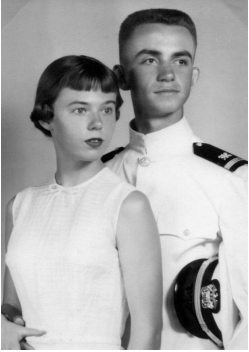
In the fall of 1964 Alan was transferred to his next destination, San Diego. Soon after arriving, he trained at the Navy Exchange Management School for his position as a Supply Corps officer. Alan explained that the Navy Exchange was like a department store for the Navy. Not long after their arrival, Alan and Jean rekindled their friendship with Guy McCaskie, whom Alan had met on a Point Reyes Christmas Bird Count in 1957 or 1958. They soon met Virginia (Ginger) Johnson, a birder and neighbor on Point Loma. Through Guy, Alan and Jean met Cliff Lyons. Not long afterwards, Pierre Devillers and his wife Xenia arrived on the scene. Pierre, a graduate student studying plasma physics at UC San Diego, was also a keen birder. The WFO founders had converged.
In San Diego, Alan chose the family’s house for its location on Point Loma and for the garden. Beginning early in 1965 Alan and Jean set up nets for banding birds, as did Ginger in her nearby yard, and collectively they contributed much to understanding the migration of birds in southern California. Ginger banded birds there for half a century. Between them, they caught many rarities, including California’s first Kentucky Warbler (caught initially at Jean and Alan’s at 08:00, later at Ginger’s at 15:00), first Mourning Warbler, and first Eastern Whip-poor-will, along with a late spring Connecticut Warbler at Ginger’s on 4 June 1968. Guy became part of the family—Alan later guessed that Guy joined them for three or four dinners a week. In 1968, Alan and Jean were witnesses when Guy was sworn in as a U.S. citizen. Gradually, discussions began about starting a new organization devoted to field ornithology. Guy wanted to start a rarities committee and a journal in which to publish its reports, as well as papers on all aspects of field ornithology, on the model of British Birds and the newly created Belgian Aves, established 1964.
By 1967, the founding group of six felt ready to meet with others and assembled in Pacific Grove, at the home of Alan and Sheila Baldridge on the afternoon of 7 October after a Monterey pelagic trip. They agreed to move forward with starting up a new organization and publishing a quarterly journal. Jerry Johnson, an attorney, wrote the bylaws, and Ginger and Alan sought out a printer for the journal, eventually settling with Crest Offset Printing in National City, just south of San Diego. Crest offered quality printing at a good price, as it has done for WFO faithfully for 56 years. In the fall of 1969, letters were sent out to prospective members inviting them to join this new organization devoted to field ornithology. As I recall, the annual membership fee was $10.00. Volume 1, number 1 of California Birds was published in January 1970.
As Judith Dunham described in her newsletter article (The WFO Logo– A Brief History, Summer 2023), the iconic logo for this new group was the Sabine’s Gull, the illustration done by Ginger Johnson. What Judith did not know was how the sketch came about. In June of 1969, three of our founders (Guy, Ginger, and Cliff Lyons) embarked on a trip to west and south Texas. They left during the day on 27 June 1969 and by afternoon were near Seeley, California, on Interstate 8. There on the freeway they encountered an adult Sabine’s Gull dodging traffic. Ginger drew a sketch of the bird on the spot and it became our logo, one that has appeared on all WFO’s products. When thinking about Sabine’s Gull, most birders tend to think of the open ocean, not of one negotiating a freeway through the Imperial Valley!
That first issue of January 1970 opened with an editorial—a statement of purpose, so to speak—by Alan. The opening paragraph: “This, the first issue of California Birds, marks the inauguration of a publication which hopefully will earn a place among the major ornithological journals. It will have, however, a rather different approach than most of those journals in that it will be devoted almost exclusively to field ornithology.” Guy McCaskie followed with his own editorial titled “The Functioning of the Rare Bird Committee.” The California Bird Records Committee (CBRC) was formed as a committee of CFO. Alan was one of the charter members and remained on the CBRC through 1977. The CBRC was modeled after established rarities committees in the U.K. and Belgium, which Guy and Pierre knew well. It was the first records committee in North America.
Alan explained to me that the founders gathered at their home on Point Loma and passed the manuscripts for the new journal around the table for review. After decisions and corrections were made, the issue was taken to the printer for publication. Once printed, the issues were put into mailing envelopes. Wendi and Robert Craig assisted. Fifty-four years later, Wendi remembered the stuffing of the envelopes and told me that even though she didn’t fully understand this new organization, with which her parents and their friends were consumed, assisting made her feel a part of it.
The leaders of CFO were equals who shared the duties. Jean explains, “all the founders had an equal part as it was strictly to constitute a framework for the journal that we had decided to publish. At the origin it had no other function.” Early on, Joseph R. Jehl, Jr. was brought in to help with the editorial work. I asked Alan what Joe did, and he said he “was always there and willing to help.” Joe commented to me not long ago that he did “anything he was asked.” Western Field Ornithologists honored both Jerry Johnson and Joe Jehl at the 2018 Ventura conference with WFO’s Outstanding Service Awards. Joe’s son Dan read a moving speech his father had written about the early years of the organization. In 2024, Joe wrote to me that he felt that Western Birds had replaced what the Condor of the Cooper Ornithological Society used to be. No greater compliment could have been given, as from the beginning this had been the founders’ goal.
I do not know the shape of that table at Alan and Jean’s house on Tarento Drive where the founders gathered so often, but I would like to imagine it was round. San Diego seemed the perfect spot, indeed Camelot. But like that mythical place, sadly, it didn’t last. Changes were afoot. Pierre had completed his doctoral studies at UC San Diego and returned to Belgium in the fall of 1971. Jean left California in February 1972 for Belgium to be with Pierre, after she and Alan were divorced the previous month. School could not be arranged for the children in Belgium, so they remained with Alan. The couple had moved on to new phases in their lives.
The content of those first three volumes was remarkable, especially for its time, and I urge readers to revisit those first 12 issues, all available freely on the WFO website: Western Birds.
Toward the end of 1972, an acute shortage of articles brought the survival of the organization into question. Richard (Rich) Stallcup sounded the alarm that California Birds was folding.
The alarm was heard. The details, the timing, and the participants of the events that followed are not entirely clear to me, but I have tried to piece them together as accurately as possible. Alan, Jeannie Conry, Bruce Webb, and Tim Manolis, who were involved in the events, have searched their hazy memories and related to me that around late 1972 and/or early 1973, two meetings were held to resuscitate California Birds. The first was held in Chico, California, at Jeannie’s home. Rich Stallcup, Bruce Webb, Tim Manolis, Jeanne Conry, Ron LeValley, and Alan participated; Tim believes that Jon Winter was there too. The Chico meeting sparked the subsequent meeting that led to significant changes. At this follow-up meeting in the San Francisco Bay Area Tim remembers a large group, including Joseph (Joe) Greenberg and his sons Russell (Russ) and Douglas (Doug). Laurence (Laurie) Binford must have been there too, as many of the steps taken involved him. Alan had met Laurie in Chicago in the mid-1950s, and Laurie had contributed important papers on the waterthrushes to California Birds. Curator of birds and mammals at the California Academy of Sciences, Laurie would become a pivotal figure in the years ahead with WFO. Rich Stallcup was for decades a leading northern California birder (see his obituary by Jon Winter in Western Birds 44:155–157).
On a personal note, may I add that I learned of these meetings only in late November 2025 from Bruce Webb and Tim Manolis. The details of who, where, and what was discussed are clouded by the fog of time. As I tried to research the facts, Lincoln’s sentence from his famous Gettysburg Address came to mind: “The world will little note, nor long remember, what we say here, but it can never forget what they did here.”
At that meeting, the decision was made not only to continue the organization but to change its name to Western Field Ornithologists and to broaden its reach to include all of western North America, as well as Hawaii, and the northeastern Pacific Ocean. Alan clearly spelled out the result of that meeting in his opening editorial in Volume 4, page 1, of the newly renamed Western Birds: “This expansion is designed to increase the flow of manuscripts, the shortage of which has made it impossible to publish California Birds on a regular schedule, and to provide a medium for publication of field studies from those areas of the West where no state or other local publication of a similar nature exists.” A new editorial board was formed, with the goal of including field experts from each western state and province, an effort organized by Laurence Binford, Mrs. Hubert Fry, and Stephen F. Bailey. The board’s purpose was to solicit papers and promote membership within their states and/or provinces, and to review papers within their sphere of expertise. Alan was asked to be the sole editor of Western Birds. He accepted, but only reluctantly, as he felt there were folks at the meeting better qualified to take on that task, and his own life had become complicated. When Alan took over, the journal was far behind schedule, and then more completely unedited manuscripts were dumped in his lap. Those who knew Alan know of his humility. But he was a gifted editor, and during his 13 years as sole editor, he always gave the job the full attention it required. Dale Zimmerman and Steve Russell were also important reviewers on whom Alan relied. It appeared that WFO had stabilized. Officers for the organization and the conferences—the staples that are part of the WFO we now know—came soon.
By then Alan had moved from active duty to being a lieutenant in the naval reserves, a position he retained until July 1980. He had been pursuing a master’s degree at San Diego State University. While still a student, Alan was hired by the state of California, initially to work for the Department of Transportation in Fresno for one year, then for the California Department of Fish and Game (CDFG). His early assignments with that agency included study of the black bear and assessing deer habitat.
In the summer of 1973, Alan moved from Fresno to Chico, where Jeannie Conry assisted in caring for Alan’s children, Robert and Wendi. Jeannie told me recently that Alan was the best dad in the world. It was in Chico that he became life-long friends with Bruce Webb (who later married Jeannie) and Tim Manolis. Alan continued deer surveys for CDFG, the family living on Honey Run Road near the covered bridge. His home became the editorial hub for Western Birds, and he relied heavily on Bruce, Jeannie, and Tim for editorial assistance. They worked together in the evenings, always providing authors positive feedback in the kind manner typical of Alan. And always with a bowl of ice cream to make the work more enjoyable!
After Chico, in the summer of 1976, Alan moved back to Carmichael, returning to the area where he had spent many of his formative years. With CDFG, he was now assigned to work on nongame species, including administering contracts for bird research and heading up the Least Tern Recovery Team. Alan became a member of the Sacramento Area Rare Bird Committee. In 1975, at the Barranca Rancho Liebre in Sinaloa, Alan met Narca Moore. In 1978 she moved into the Carmichael house where she worked closely with Alan on Western Birds. I can assure you from this writing that Narca is also a gifted editor. They were married in March 1980 by Judge Earl Warren, Jr., the son of Earl Warren, former California governor and later chief justice of the U.S. Supreme Court. Two Wood Ducks flew by during the ceremony near the American River. In 1982 they moved to a newly established state refuge, the San Jacinto Wildlife Area southeast of Riverside, where Alan became the area’s first manager.
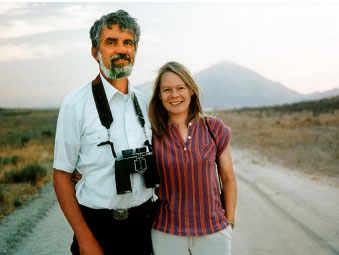
During this time of seemingly continuous transitions in Alan’s life, he found time not only to edit papers for Western Birds but to solicit high-quality manuscripts and help grow WFO. Having enough articles for an issue of Western Birds was always a problem, and delays resulted. But Ginger was there, serving as the graphic designer and finding appropriate spots to insert beautiful art work, which greatly enhanced the overall feel of the journal. Ginger was involved with the production of Western Birds and with WFO for 52 years, quietly but ably performing numerous tasks. From my memory she never missed a board meeting and was devoted to the production team and to the organization. I urge readers to read Diana Herron’s obituary for Ginger, who passed away in 2024 (Western Birds 55:153–154). Over the years the organization stabilized. In Terry Wahl’s presidential message (Western Birds 14:197) he thanked the entire production team for succeeding in bringing WFO’s journal up to date. Shortly thereafter he announced that WFO had also become fiscally sound.
Since Alan’s death I have carefully looked through all 64 issues in the 16 volumes (1970–1985) of California Birds/Western Birds that Alan oversaw, mostly as the sole editor. That effort inspired me to list 55 papers in those issues I want to read, or read again. I also came across the bylaws of the CBRC (Western Birds 8:161–165), written by Laurence C. Binford. Not only was the CBRC the first rare bird committee in North America, to my knowledge it was also the first to have detailed bylaws. Today there are rare bird committees for nearly every state and province, and their bylaws are all, or nearly all, modeled after those Laurie wrote. In Volume 10, the first color appeared, a plate of Hawaiian honeycreepers by H. Douglas Pratt. One especially notable early article, always worth a read, is “Why neglect the difficult?” by Allan R. Phillips. It opens, “Eastern birds appear to stray west only if they lack western relatives, just as migrants ‘used’ to arrive only on weekends.” That this leading if controversial taxonomist contributed to Western Birds is a tribute to Alan Craig and his team.
Alan retired from CDFG in late 1990, just before he and Narca went to Australia. After returning, they lived on the Gray Ranch in southwest New Mexico during 1992 and in Guadalupe Canyon from March 1993 to April 1994. During those years, Alan became a charter member of the New Mexico Bird Records Committee, at the invitation of Sartor O. (Sandy) Williams. Alan lent his experience with the California committee as the New Mexico committee developed its rules and formulated the state list and the review list. Alan served on the New Mexico committee through 2008. Sandy related to me that “Alan was an important ‘cog’ in the wheel of NM birding, and along with Narca, he kept me informed of happenings in the southwest corner of the state. He was especially helpful to me (and others) in gaining access to lands that became increasingly difficult to access as the 2000s began rolling along. Alan often accompanied me on field projects (feeding the mosquitoes in Skeleton Canyon; dodging rattlesnakes in the Playas Valley, etc.).”
John Parmeter remembers backpacking into the very remote Animas Mountains with Alan and Narca, camping overnight at Cistern Saddle. Those hikes yielded many notable discoveries, including the Spotted Owl, Buff-breasted Flycatcher, and White-eared Hummingbird, as well as the varied habitat use of the Mexican Chickadee.
John also remembers well, as do I, the third annual meeting of the CBRC on 27 November 1976 when Alan was still a member. John and I were not members but were invited to be observers. During the meeting, a sight record of a Band-rumped Storm-Petrel off San Diego in September of 1970 was debated vigorously. The record had circulated several times and was up for a final decision at that meeting. Alan finally said that for him there was enough doubt that it shouldn’t be on the state list. Hearing that, Laurie Binford joined Alan’s dissent and the record wasn’t accepted. Alan had actually seen the bird so might have had a self-interest in accepting it, but stuck to what he felt was the best decision. Subsequently the record was reviewed again and accepted, then rejected again when the variation within Leach’s Storm-Petrel was understood better. When the laconic Alan did speak, his words carried much weight.
It was after Alan and Narca moved to Portal, Arizona, in 1994 that I got to know them much better. We talked about old times, talked about New Mexico ornithology, and I helped on his Christmas Bird Counts. At some point during our evening visits, Alan’s face would light up into a broad smile and he’d say, “let’s have some ice cream!”
At the WFO conference in San Diego in the fall of 2014, Alan, Narca, Jean, and Pierre were all there. It was likely the first official WFO event that Pierre and Jean attended. They were celebrated by WFO for their contributions as founders. Of course, Guy McCaskie was there, as he tries to attend all WFO conferences. Ed Pandolfino gave a talk about the founding of WFO, his thesis being that Guy and Pierre were the driving force in creating this new organization.
On Sunday when the conference ended, Guy and I led a trip to the south end of the Salton Sea. Alan, Narca, Pierre, and Jean were all participants. On one of the evenings, our group had dinner together. I sat next to Pierre and Jean. I hadn’t seen them in 45 years. I thanked Jean and Alan for being so kind to a young teenager nearly a half century in the past. Back then, Jean would talk to me on the telephone for hours—I lived vicariously through the descriptions of all of the wonderful birds they were finding in San Diego, many of them in their yard! Kindness and respect can mean a great deal to the young people who are finding and establishing their own lives.
By 2020, Alan was volunteering his time at the U.S. Forest Service’s visitor information center in Cave Creek Canyon. He was also on the board of directors for the Friends of Cave Creek Canyon, the organization instrumental in preserving Willow Tank in the San Simon Valley southeast of Portal. Open to birders, this place is an important stop for migratory water birds, and the surrounding desert is a good place to find the Crissal and declining Bendire’s Thrashers. Fellow board member Rene Donaldson says, “Simply on the board does not describe the position accurately. He was always the voice of reason [and] wisdom, and [always] levelheaded. He never talked much, but when he did we all stood at attention. I miss him terribly as we always backed up one another.” She adds that the single word she would use to describe Alan is “sagacious.”
In 2020, he met Debra Davison, another volunteer working in the center. She was a relatively new, but enthusiastic, birder, and Alan always loved to mentor new birders. Eventually Alan and Narca decided it was time for a life change, and they amicably divorced in May 2021. Soon after, Alan and Debra were married near Saguaro National Park. They both loved the desert. They birded throughout western North America, as far as Alaska, as well as in Latin America. Wendi commented to me that their days were filled with much laughter and happiness. Debra wrote to me that they had many great adventures together. In the early summer of 2023, Alan was diagnosed with cancer, which affected their traveling mobility. Still, they had times when they could get afield, including a trip with Wendi to Colombia in early 2025, where I narrowly missed seeing the three of them at Araucana Lodge in the western Andes.
In mid-October 2025 Alan’s health suddenly crashed. Wendi, Robert, and Hollin Stafford (Narca’s daughter, adopted by Alan) were there visiting. The three grown children, Debra, and Barbara Stoddard (a close friend of Alan and Narca for over 30 years) were present when Alan passed away on 17 October 2025. He is survived by his wife, Debra Craig; his children, Wendi Craig, Robert Craig, and Hollin Stafford; his grandchildren Meeka Lãpuşte, Leona Zachery, and Mia Stafford; and his great-grandson, Ian Lãpuşte. Alan is the third of WFO’s founders to have passed, following Clifford (Cliff) Lyons in 2012 (see obituary by Jon Winter, Western Birds 43:192) and Ginger in 2024 (obituary noted above). Wendi emailed me shortly after her dad’s passing, and told me that she thought Alan held on to life for that last planned visit. They were heartbroken by his passing, but relieved that he would no longer suffer, although Alan “always claimed to be fine.” When I mentioned this to Narca, she said “that’s Alan” and told me that Alan had adopted the response of Drum Hadley (Alan’s boss when they lived in Guadalupe Canyon) to the question “how are you?” After a pause Alan would always answer, “my best day ever!” In addition to everything else, Alan was a Stoic. Alan and Narca’s longtime friend and birder Cathie Sandell wrote to Narca, “I’m guessing Alan died as he lived, fully present.”
I’m convinced that the organization we have come to treasure would have collapsed soon after its promising start without Alan’s total dedication. Through his perseverance, and with help from his colleagues and close friends, Alan succeeded. I talked about this with Guy McCaskie both before and shortly after Alan’s death, and he agreed. Shortly after Alan’s passing, Guy posted his own thoughts on Alan’s importance.
In 1987, and after Laurie Binford’s suggestion, WFO created the Alan M. Craig Award for “exceptional service, leadership and dedication to WFO over a sustained period of time.” Alan was the first to be honored with this award. No one deserved it more. In 2010, Virginia P. Johnson received the Alan M. Craig award. The original award was a bronze sculpture of a Sabine’s Gull.
In Alan’s last issue of Western Birds, on page 198, at the end of the index for Volume 16, 1985, is a sketch by Tim Manolis of three alternate-plumaged Sabine’s Gulls over the ocean waves. Tim’s sketch conveys much more to me personally than a photo ever could. Of our six founders, three have passed, three are still with us. When I looked at the three sketched gulls, I wondered if they were the three who had passed, or the three still with us. For the former, let’s embrace and celebrate their memory, and for the latter let us thank them for being our founders and for doing all that that they have done for WFO.
Finally, on a personal level, Alan was the kindest, steadiest, and least judgmental person I have ever met.
ACKNOWLEDGMENTS
This remembrance would not have been possible without the help of many, and all I asked graciously assisted. The late Cliff Lyons was a close friend in the mid-1970s, and we talked often about the early years of CFO, some of which I remember well. Over much of my life I have talked about CFO and WFO with Guy McCaskie, including his close partnership with Pierre. Tim Manolis and Bruce Webb talked to me recently about the troubled period in the early 1970s. James Shiflett, a close friend of Alan, shared his thoughts. Rene Donaldson sent Narca her memories of Alan on the board of Friends of Cave Creek Canyon and all that he did. Sandy Williams offered much detail about Alan’s contributions to New Mexico, and John Parmeter relayed that seminal moment at the CBRC meeting in 1976. Jean Terschuren, Pierre Devillers, Wendi and Robert Craig, Bruce Webb, Jeanne (Jeannie) Conry, Tim Manolis, and Debra Craig read the entire manuscript and offered many useful suggestions and corrections. Narca, Bruce, and Jeanne were meticulous editors in their review. WFO was so fortunate to have them as reviewers for Western Birds. I am most grateful to Narca for working with me the entire way: Long conversation, countless hours of editorial review, and most of all a deep need for both of us to get it right. Moreover, we wanted not only to detail the events and accomplishments of Alan’s life, but to express how we felt about Alan as a person. I sensed the same feeling from all of those who assisted in preparing this obituary. This was indeed a fully cooperative effort throughout. There is unanimous agreement that Alan’s long life was well-lived.
Jon L. Dunn
20th president of WFO
31 December 2025
Dear Alan,
You will be buried today. I am ready now to write to you in a public forum. What a journey we shared, stretching back to that Christmas Eve in 1975, at Alden’s Barranca in the mountains of southern Sinaloa, Mexico. You walked up to my campfire, where I sat playing “Bridge Over Troubled Waters” on my recorder. A Stygian Owl huu’d backup, and perhaps 60 Thick-billed Parrots roosted over my tent.
Birds knitted us together. We reunited next at the 1978 Arizona meeting of Western Field Ornithologists, when we were both ready for a new partnership and a new marriage—one that lasted more than 40 years. We explored the world together, worked together with WFO and its journal Western Birds, and sojourned for nearly 9 years (1982–1990) at San Jacinto Wildlife Area, where you were its first manager, and where we lived on an island of sanity in the sea of insanity that was southern California. You were so happy, after administering contracts on behalf of endangered birds, to be able to restore habitat that had been ripped up for agriculture in the 1920s. Every wet year, the land remembered it was a wetland. On the wildlife area, you could see the fruits of your labors. You used to wonder how anyone could be depressed, when all they had to do was to step outside.
Our honeymoon was a memorable month in Peru in 1980. Ted Parker’s field notes guided our explorations. There were no real field guides, only de Schauensee’s Birds of South America and Maria Koepcke’s Birds of the Department of Lima, Peru. We took copious notes by day and tried by night to figure out what we had seen. Photos of enigmas we sent to Ted after our return, for his help with the identifications.
At home, you were dedicating much of your free time—away from your job as a biologist with (then) California Department of Fish and Game—to working on Western Birds. Even when we went rafting down the American River, you would bring along a manuscript to read, or ask me to read a manuscript to you, so that you could proof a galley as we drifted in the current.
You saw the need for a network of highly-qualified reviewers living in other western states; those reviewers would know well their states’ avifaunas, and be best positioned to evaluate papers dealing with local birds. You combed the West to find your reviewers, and asked me to liaise with them. Prominent scientists like Steve Russell from Arizona and Dale Zimmerman from New Mexico contributed to the excellence of the journal.
Throughout your time working on Western Birds, you could always count on the support of Laurie (Laurence C.) Binford, an extraordinary field ornithologist, superb reviewer, and your close friend since at least 1955, when he showed you your first Blue Jay in Chicago.
In 1986, after 16 years as editor of California/Western Birds, you passed on the task to Phil Unitt. You were very relieved that it went into the hands of someone so capable and dedicated as Phil. His high standards have never flagged.
On the San Jacinto Wildlife Area, you were especially proud of the system you developed to bring treated secondary water from the Hemet–San Jacinto wastewater treatment plant to the wildlife area, where it ran through a series of ponds and newly restored marshland. Biological processes then further purified the water, as it filtered through the marsh vegetation. This water source provided stable augmentation to the rains that might or might not come. The habitat—and birds—very quickly responded. A big Tricolored Blackbird colony soon gathered. Ornithologists visiting the area in the early 1900s had commented upon the abundance of Lesser Nighthawks. When we arrived in 1982, we saw none. When we left in 1990, they once again were regular summer residents. Increasingly, interesting rarities appeared, such as the Lark Bunting, Sprague’s Pipit, and American Tree Sparrow.
You found that one major management hurdle on the wildlife area was the charming presence of Stephen’s Kangaroo Rat (Dipodomys stephensi). The species was known to be in jeopardy, but very little was known of its habitat requirements. You asked me to undertake a live-trapping study, under the guidance of Dr. Mary Price at the University of California, Riverside, so that you could make wise decisions regarding its welfare. After our research, and some further study, Mary successfully petitioned the U.S. Fish and Wildlife Service to list the species as endangered, and you knew exactly the band of habitat that needed to be protected—above the floodplain, and below the steep mountain slopes.
The wildlife area had enthusiastic support from birders from its inception, particularly friends associated with San Bernardino Valley Audubon Society, like Gene Cardiff, Chet McGaugh, and Bob McKernan (later president of WFO). You faced serious challenges to the wildlife area’s integrity, and you could always count on their help—and the help of a certain reporter from the Los Angeles Times, when the public needed to know about behind-the-scenes shenanigans.
After you retired from Fish and Game in late 1990, we spent five months rambling through Australia, before returning to volunteer for a year (1992) on New Mexico’s Gray Ranch, then owned by The Nature Conservancy. On the Gray, we lived at the Culberson Camp, an old adobe in the southeast corner of the ranch, which had been commandeered by General Pershing to use as his headquarters from 1916 to 1917. (Pershing was chasing Pancho Villa around the borderlands during the Mexican Revolution, which ended in February 1917.) For electricity, we set up our early-vintage solar panel. We helped to develop a docent program for the Gray, and researched the Mexican Chickadees and Yellow-eyed Juncos that lived high in the Animas Mountains.
What drew us to the Gray Ranch, now known as the Diamond A? This remote outpost in the bootheel of New Mexico has stunning biodiversity. The Continental Divide runs through it. Eastern birds meet western birds, and those of the Rocky Mountains overlap with those of Mexico’s Sierra Madre Occidental. The Animas Mountains lie entirely within the ranch’s boundaries—a classic sky island range of the Southwest. And it had all been very little explored by ornithologists. During the 1800s, biologists associated with the U.S.–Mexico Boundary Survey, including Vernon Bailey and Edgar A. Mearns, had visited. The number of more recent ornithologists who had wrangled permission to mount an expedition to the ranch could be counted on one hand. John Hubbard was prominent among them; he had documented the presence of White-eared Hummingbirds high in the Animas, among other findings. Reptiles, butterflies, and mammals are equally diverse. In the U.S., the elegant, highly endangered White-sided Jackrabbit lives only on the Gray. How could we resist the allure of possibly contributing to the field science of such a little-known wilderness?
On the Gray, every time we stepped outside, we felt as if anything were possible. In the deep night, an Elf Owl would chuckle, or a Mountain Lion would scream. A Banner-tailed Kangaroo Rat would flash past. Young American Badgers tumbled in the relict Plains Grassland of the southern Animas Valley. In that same grassland, we honed our technique for actually seeing skulkers like the Grasshopper and Baird’s sparrows. We explored the eastern flank of the Animas Mountains, which is far more convoluted, folded, and difficult to access than the western flank. (The west, in contrast, is delineated by a crisp fault line, running alongside the Animas Valley.) We climbed to the heights of the Animas Mountains, searching out the Spotted Owls and Buff-breasted Flycatchers. We discovered that the habitat occupied by Mexican Chickadees was more diverse than in the Chiricahuas—a situation, which we figured was the result of the ever-shrinking extent of coniferous forest in the Animas. To fit in socially, we needed a bit of camo: you bought the cowboy hat; I bought the cowgirl boots. This was our life on the Gray, during that small window of time when access was even possible. (It no longer is, except on the sole public road running south through the Animas Valley. The northwest corner of the ranch can be birded by a few participants on the Peloncillo Mountain Christmas Bird Count, now being compiled by Nicholas Pedersen.)
Our year on the Gray also gave us a close-up view of the larger birding and field ornithology scene unfolding in a state far removed from California. Birding in New Mexico had been galvanized by the arrival of two long-time WFO members: first, Jerry Oldenettel, soon followed by John Parmeter. They brought a passion and a commitment to learning the state avifauna in depth, very like that which had energized the original founders of WFO. New Mexico also had its own long-time and talented residents, like Sandy (Sartor) Williams, Christopher Rustay (who mentored a new generation of New Mexico birders), and the eminent ornithologist Dale Zimmerman. What a network they formed! You and I could see the trace of Guy McCaskie’s and WFO’s influence, as it spread and amplified and supported field ornithology across the West.
Sandy decided that it was high time for New Mexico to have its own bird records committee. Since you knew the California Bird Records Committee intimately—having been there at its inception, served on it, and observed what worked and what didn’t—you were uniquely positioned to help Sandy navigate, as he worked out the structure of the new committee. Of course, he tapped you to serve on the inaugural New Mexico committee. At that point, we had just moved to Arizona, and you told him that the only thing worse than having an ex-Californian on the New Mexico Bird Records Committee was having an ex-Californian who lived in Arizona. Sandy was not dissuaded.
The Nature Conservancy found that, even with its great resources, it couldn’t maintain the Gray Ranch Preserve without impairing all of its other programs, and so it began to hammer out the sale of the ranch to Drum Hadley and the Animas Foundation. TNC relocated us to their preserve in Aravaipa Canyon, Arizona. Then, a scant week later, an enormous flood washed out the Aravaipa road and stranded us for three weeks behind the floodwaters. We watched trees and telephone poles bob past the house. Somehow, our telephone continued to work. John Cook from TNC called us, saying that Drum had to fire his Mexican cowboys because of suspected cooperation with drug smugglers, and would we like to work for Drum? You asked what our job title would be, and John responded, “Mexican cowboy!” We agreed that that would be a novel addition to our résumés. So, next stop—a year living in fabled Guadalupe Canyon, from March 1993 to April 1994.
We marveled at how we came to be in this canyon, which originates in New Mexico’s Peloncillo Mountains, cuts through the extreme southeastern corner of Arizona, and continues downstream into Mexico. Guadalupe, with its riparian habitat snaking along at the foot of high cliffs, is a highway for birds venturing north from Mexico. Here, the Buff-collared Nightjar and Fan-tailed Warbler were first discovered in the U.S. Here, the Violet-crowned Hummingbird found its first real toehold in the States. Here, you and I spotted New Mexico’s first Berylline Hummingbird: you saw it from outside at the hummingbird feeder, and I saw it arrive from inside our ranch quarters, and we ran to find each other.
After those wanderings through the West, in April 1994 we finally settled in Portal, Arizona, at the foot of the Chiricahua Mountains. You and I immediately became involved in conservation efforts there, joining the board of the Chiricahua Regional Council. CRC formed around opposition to a gold mine next to Portal. In the end, Newmont Corporation voluntarily withdrew its plans for a mine, but, unbelievably, CRC still had to fight the U.S. Forest Service, to fend off mining development, until an act of Congress withdrew this area from the possibility of mining. Noel and Helen Snyder (of condor fame) spearheaded that important effort.
Bob Scholes, living at the Scholes’ Research Ranch in the Peloncillo Mountains, had initiated and long compiled the Peloncillo Mountains Christmas Bird Count, which encompassed the northwestern corner of the Gray Ranch. He correctly saw you as the perfect inheritor of the effort. You fully supported the citizen science embodied in Christmas Bird Counts, and compiled the Peloncillo count for 11 years, beginning with the 1996–97 season. Organizing the Peloncillo count was much more complex than organizing most CBCs. For virtually all of the count circle, you had to arrange for permission from landowners for counters to enter. Mistrust of anything hinting at environmentalism was rampant, yet you would don your big cowboy hat and knock on their doors. You won over almost all of the landowners; I can think of one holdout, who never met you face-to-face. The ranchers sized up your character, and said yes. Once they had given you the combinations and keys to all of the locked gates, you would go around and check that they all worked, before passing them on to the participants. I saw how diligently and gracefully you handled that very difficult CBC. Your efforts allowed many birders, who were eager to explore even a small corner of the Gray Ranch, exactly that opportunity. Many a rarity was discovered on the Peloncillo CBC, and many a national high count was achieved for various species.
When the Friends of Cave Creek Canyon formed, you joined its board. One project you undertook with Rene Donaldson and others, was the restoration of Willow Tank, the site of Arizona’s first accepted record of the Trumpeter Swan. You had come full circle, back to nurturing habitat on a bit of degraded land.
Of course, your earlier life married to Jean Terschuren was foundational to who you were. The two of you were not only among the founders of WFO, but as bird banders you contributed important discoveries. (I always thought that you were both very brave to band puffins in Alaska, considering the abuse that even a chickadee can inflict upon an incautious bander.) Your fellow founder, bander, and friend— Ginger Johnson—confided to me that you were the first person to recognize the phenomenon of fallouts of migrants on peninsulas that jut into the Pacific Ocean. It seemed very important to Ginger that you receive credit for that discovery. She knew your modesty.
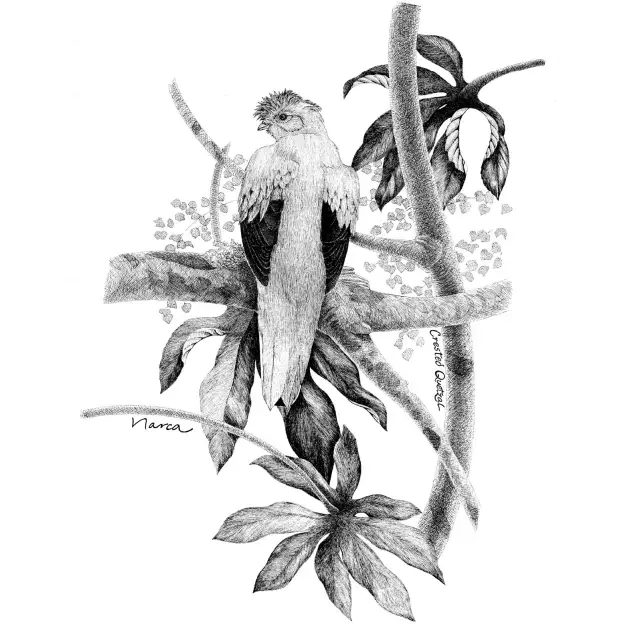
In addition, our shared children, grown long ago—Wendi Craig, Bert Craig, and Hollin Stafford—were frequent companions on our forays near and far. They profoundly enriched our years together. We found Hollin’s article in BirdWatching magazine, “Raised by Birders,” to be quite entertaining.
Eventually, we chose to walk separate paths, so that each of us could best continue to embrace life. You went with Debra to enjoy a nomadic life and the thrill of a new relationship. I stayed in the Chiricahua Mountains with Jim. It was good to see you one last time, shortly before you died. And now, you’re off to a new adventure.
Bon voyage, my dear friend.
Narca Moore
7th President of WFO
10 November 2025
Al Craig was my boss at Kodiak Naval Station. In off-duty hours, my wife Liz and I spent a fair amount of time with Al and Jean. Our small duplexes on the Station were about 100 feet apart. About 30 minutes after the ’94 Alaska Earthquake, with our eight-month-old son, we gathered with the Craigs and their two children in their living room and together survived the very destructive tsunami that came later. Al was at all times calm, cool, and collected. He is one of the best men I have known in my 88 years. The last time I saw him was in San Diego in 1966. As public relations director for the Oakland Raiders, I was in town for a game and had lunch with Al and Jean at a downtown restaurant.